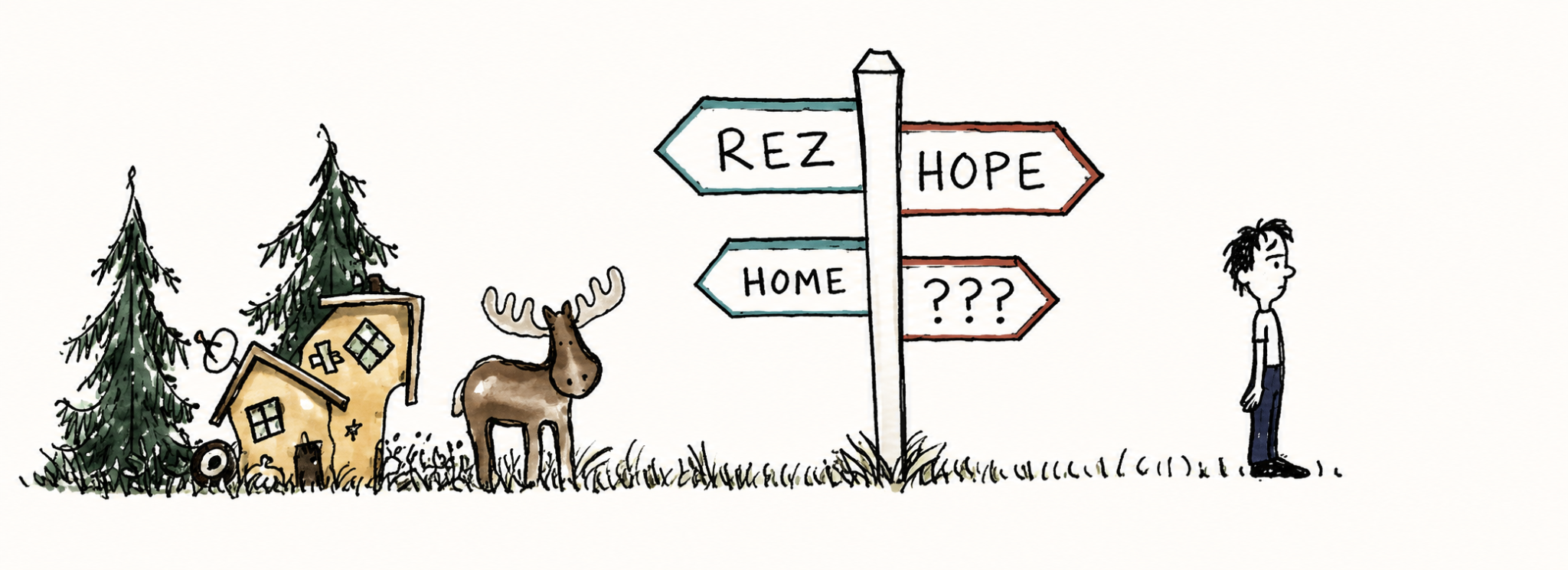
As you meet this person, notice what they want and what they do.
Junior wants a bigger future and a way to be heard.
Junior wants new chances while keeping the people he loves in his life.
Academic explanation
Characterization means how a writer helps us understand a person through actions, words, and relationships.
Elaboration
Choose one action from the evidence available this week. Explain what it suggests, then look for another detail that supports or complicates that idea.
Junior explains drawing as a way to communicate beyond himself.
“So I draw because I want to talk to the world.” (Alexie 6)
What it shows: Junior uses drawing to reach people. He wants his experiences to matter beyond the people who already know him.
He and Rowdy spend time together without making the game about winning.
Whole-book explanation
The gist
Junior wants a bigger future without losing the people he loves.
Academic explanation
Junior is the first-person narrator, so we see events through his changing point of view. His main conflict involves opportunity, loyalty, and belonging.
Elaboration
Junior uses drawings and jokes to make painful experiences easier to express. At Reardan, he discovers that new friendships can exist alongside love for his family and Rowdy. He also revises his own judgments: winning a game does not feel like success once he notices the pain of the losing team. His feelings deserve attention, but a feeling or prediction is not automatically a fact.
Rowdy
The gist · at this point in the story
As you meet this person, notice what they want and what they do.
Rowdy acts tough, but he shares dreams with Junior in private.
Rowdy feels hurt by Junior’s school choice. His anger is evidence of his feelings, not proof of Junior’s motives.
Academic explanation
Characterization means how a writer helps us understand a person through actions, words, and relationships.
Elaboration
Choose one action from the evidence available this week. Explain what it suggests, then look for another detail that supports or complicates that idea.
Junior describes the private hopes Rowdy shares with him.
“And he only talks about his dreams with me.” (Alexie 23)
What it shows: Junior describes a private side of Rowdy. Sharing dreams shows that Rowdy trusts him, even though others may see only Rowdy’s anger.
Rowdy tells Junior about a dream in which Junior was traveling.
“You looked happy. And I was happy for you.” (Alexie 229)
What it shows: Rowdy imagines Junior far from home and feels happy for him. He begins accepting a future they will not experience in exactly the same way.
He says he is happy for Junior’s imagined future and plays basketball with him again.
Whole-book explanation
The gist
Rowdy cares about Junior, but his fear and anger often lead him to hurt the friend he misses.
Academic explanation
Rowdy is a complex character: his protective actions, vulnerability, and violence do not fit one simple label. His changing response to Junior’s transfer develops the conflict over loyalty.
Elaboration
Rowdy first sees leaving Wellpinit as being left behind. His anger helps explain his actions, but it does not excuse hitting Junior. The memory in Chapter 10 shows earlier trust, not a repair of their present friendship. Near the end, Rowdy begins to imagine a future in which Junior can leave and still matter to him.
Mary / Mary Runs Away
The gist · at this point in the story
As you meet this person, notice what they want and what they do.
Mary has hopes that Junior has not fully understood.
Mary makes a change. Junior starts taking her hopes more seriously.
Academic explanation
Characterization means how a writer helps us understand a person through actions, words, and relationships.
Elaboration
Choose one action from the evidence available this week. Explain what it suggests, then look for another detail that supports or complicates that idea.
Junior reconsiders Mary’s decision to change her life.
“But I just kept thinking that my sister’s spirit hadn’t been killed. She hadn’t given up.” (Alexie 91)
What it shows: Junior revises his earlier picture of Mary. Her decision to move gives him a reason to see hope where he had seen only withdrawal.
Junior remembers her courage while thinking about his own future.
Whole-book explanation
The gist
Mary still has dreams, even when Junior first thinks she has given up.
Academic explanation
Mary acts as a parallel to Junior: both seek a life beyond what others expect. Her story also shows the limits of Junior’s knowledge about another person’s motives.
Elaboration
Mr. P reveals that Mary once wanted to write, changing Junior’s picture of the sister who stays in the basement. Her move and later letters show continuing hope and effort, including a return to writing. Her accidental death does not prove that seeking a different life was wrong. Rowdy’s claim that Junior caused it must be tested against the account of the fire.
Mr. P
The gist · at this point in the story
As you meet this person, notice what they want and what they do.
Mr. P pushes Junior to seek more. Junior still needs to test what his teacher says.
Academic explanation
Characterization means how a writer helps us understand a person through actions, words, and relationships.
Elaboration
Choose one action from the evidence available this week. Explain what it suggests, then look for another detail that supports or complicates that idea.
Mr. P makes a broad claim while speaking to Junior.
“The only thing you kids are being taught is how to give up.” (Alexie 42)
What it shows: Mr. P makes a sweeping claim. The word “only” makes us ask whether his own examples and other people’s actions support every part of it.
Junior acts on the advice, while his parents’ support shows that hope also exists at home.
Whole-book explanation
The gist
Mr. P pushes Junior to seek more, but Junior still needs to test what his teacher says.
Academic explanation
Mr. P is a catalyst, a character whose actions help start a major change. His apology and advice challenge Junior’s expectations while also inviting readers to examine the teacher’s broad claims.
Elaboration
The worn textbook gives Junior concrete evidence of neglected school resources. Mr. P acknowledges harm and sees that Junior has kept his hope. However, his claim that the community teaches children to give up is his interpretation. Junior’s parents’ support and Mary’s continuing dreams complicate it; one teacher does not speak for all Spokane people.
Grandmother Spirit
The gist · at this point in the story
As you meet this person, notice what they want and what they do.
Grandmother helps Junior think about what other people’s actions might mean.
Grandmother’s care for other people helps Junior understand her final wish.
Academic explanation
Characterization means how a writer helps us understand a person through actions, words, and relationships.
Elaboration
Choose one action from the evidence available this week. Explain what it suggests, then look for another detail that supports or complicates that idea.
Junior explains Grandmother’s enthusiasm for meeting people.
“That’s the whole point of life, you know? To meet new people.” (Alexie 156)
What it shows: Grandmother values meeting people beyond the ones she already knows. Her support for Junior’s transfer grows from that welcoming attitude.
“My grandmother’s last act on earth was a call for forgiveness, love, and tolerance.” (Alexie 157)
What it shows: Junior connects Grandmother’s final request with how she treated people. Forgiveness continues her values without making the harm disappear.
Junior and his parents remember her together at the cemetery.
Whole-book explanation
The gist
Grandmother helps Junior understand people and shows how to care without making everyone the same.
Academic explanation
Grandmother’s characterization centers on tolerance and forgiveness. Her words and actions offer Junior an alternative to judging people only by group membership or responding to injury with revenge.
Elaboration
She gives Junior a possible explanation of Roger’s behavior, which he can then compare with what Roger does. Her final request for forgiveness continues her habit of welcoming people. Forgiving the driver does not mean the harm was small or that there should be no consequences. Her wake also brings people together through grief and shared laughter.
Gordy
The gist · at this point in the story
As you meet this person, notice what they want and what they do.
Gordy takes Junior’s learning seriously and helps him keep working.
Academic explanation
Characterization means how a writer helps us understand a person through actions, words, and relationships.
Elaboration
Choose one action from the evidence available this week. Explain what it suggests, then look for another detail that supports or complicates that idea.
Junior describes Gordy continuing to help him understand.
“I really didn’t, but Gordy believed in me. He wouldn’t let me give up.” (Alexie 94)
What it shows: Gordy supports Junior while Junior is still confused. His confidence is an invitation to keep working, not a claim that Junior already understands everything.
Gordy tells Junior how carefully he approaches the words in a novel.
“Well, you have to look all that up. If you don’t treat each word that seriously then you’re not treating the novel seriously.” (Alexie 95)
What it shows: Gordy turns encouragement into a specific reading habit: investigate unfamiliar words. His friendship includes asking Junior to do difficult work.
He wants to visit Junior on the reservation, connecting their school friendship with Junior’s home.
Whole-book explanation
The gist
Gordy helps Junior grow by taking his ideas seriously and making him think harder.
Academic explanation
Gordy combines friendship with intellectual challenge. He helps develop Junior’s confidence as a learner while questioning assumptions that Junior might otherwise leave unexamined.
Elaboration
Gordy first confirms Junior’s science answer because it is correct, not because they are already friends. Their relationship then grows through studying, reading, and shared outsider experiences. Support does not always mean agreement: Gordy challenges how Junior thinks about Penelope. Later, he acts with classmates when a teacher treats Junior unfairly.
Penelope
The gist · at this point in the story
As you meet this person, notice what they want and what they do.
Penelope and Junior share a project. Watch what she does when he needs help.
Penelope has goals and problems that Junior cannot know just by looking at her.
Academic explanation
Characterization means how a writer helps us understand a person through actions, words, and relationships.
Elaboration
Choose one action from the evidence available this week. Explain what it suggests, then look for another detail that supports or complicates that idea.
Penelope tells Junior she will include him in the donation.
“I’ll still put your name on the money when I send it.” (Alexie 80)
What it shows: Penelope includes Junior in the donation after his money is stolen. This is a small, concrete act of recognition.
She joins classmates who stand up for him when a teacher mocks his absences.
Whole-book explanation
The gist
Penelope has hopes and problems that Junior cannot see just by looking at her.
Academic explanation
Penelope becomes more complex as Junior learns about her vulnerability and ambitions. Their relationship tests whether he sees her as a person or mainly as a sign of popularity and status.
Elaboration
At first, Penelope is dismissive. Later she shows concern, shares her hopes, and responds to Junior’s honesty about poverty. Her ambition to create something lasting gives them a real connection. That does not settle Rowdy’s criticism completely: Junior still needs to examine how appearance and popularity influence him. Junior’s thoughts about her eating disorder are not medical advice.
Roger
The gist · at this point in the story
As you meet this person, notice what they want and what they do.
Roger’s response surprises Junior. Watch his actions before deciding what they mean.
Roger offers practical help. Compare those actions with his earlier behavior.
Academic explanation
Characterization means how a writer helps us understand a person through actions, words, and relationships.
Elaboration
Choose one action from the evidence available this week. Explain what it suggests, then look for another detail that supports or complicates that idea.
Junior narrates Roger lending him money before the confession.
“He opened his wallet and handed me forty bucks.” (Alexie 126)
What it shows: Roger responds to Junior’s immediate need with money. He offers help before Junior has told the whole truth about being poor.
He leaves Junior his uniform and encourages his future in basketball.
Whole-book explanation
The gist
Roger changes from someone who hurts Junior to someone who offers real help.
Academic explanation
Roger’s actions develop his characterization over time. Comparing his early bullying with later practical support helps readers distinguish an initial impression from a continuing pattern of behavior.
Elaboration
Roger’s racist behavior at the beginning matters and should not be excused. Later, he lends money, offers rides, and supports Junior as a teammate. Those choices give Junior reasons to revise his judgment. The story does not establish that punching is a reliable way to earn respect; the strongest evidence of Roger’s care is what he does afterward.
Coach
The gist · at this point in the story
As you meet this person, notice what they want and what they do.
Coach expects effort and stays with Junior when he is hurt.
Academic explanation
Characterization means how a writer helps us understand a person through actions, words, and relationships.
Elaboration
Choose one action from the evidence available this week. Explain what it suggests, then look for another detail that supports or complicates that idea.
Coach tells Junior that he recognizes his commitment.
“It’s perfect for you. I’ve never met anybody as committed as you.” (Alexie 148)
What it shows: Coach recognizes Junior’s commitment, not just a score. His words tell Junior that his effort is worth noticing.
He shares the team’s sadness after its own playoff loss.
Whole-book explanation
The gist
Coach expects Junior to do hard things and stays with him when he is hurting.
Academic explanation
Coach is a mentor whose combination of high expectations and personal care helps Junior build confidence. His support shows that belonging involves more than being useful to a team.
Elaboration
Coach recognizes Junior’s effort and skill, then asks him to take on difficult responsibilities. His hospital visit matters because Junior needs care, not another basketball test. Junior values their private conversation and does not tell the reader everything they discuss. We can analyze the choice to stay without inventing what was said.