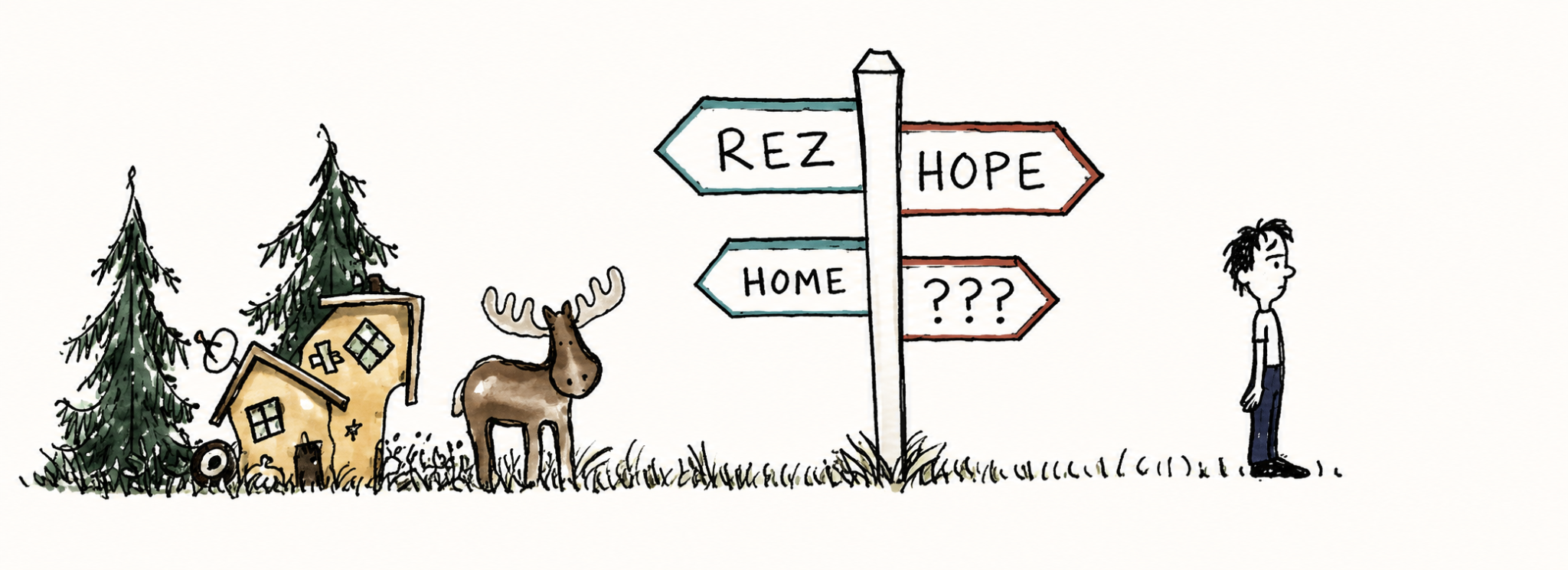
A topic names what a story is about. A theme says something about that topic.
Topic
Friendship
Pattern in the story
A friend can feel hurt by a choice that helps you.
Possible theme
People can care about each other and still need different paths.
Art and humor can help people endure pain without removing its causes.
The gist
A drawing or a joke can help you get through something hard. It cannot fix every problem.
Academic explanation
A theme is a claim about life that you develop from a pattern in the story. It is more than a one-word topic.
Elaboration
Connect two details from the chapters you have read. Explain what they suggest together. A detail that does not fit can help you make the claim more precise.
Follow the evidence
Junior compares painful experiences with floods and his cartoons with lifeboats.
“I think the world is a series of broken dams and floods, and my cartoons are tiny little lifeboats.” (Alexie 6)
What it shows: The lifeboat metaphor makes cartoons a source of help during overwhelming experiences. A lifeboat helps someone survive a flood; it does not stop the flood.
Junior compares how hurt he feels with what he tells his father after Christmas.
“If okay was the earth, then I was standing on Jupiter.” (Alexie 151)
What it shows: Junior makes a funny comparison while describing his father’s painful failure. The joke expresses how far he is from okay; it does not mean the hurt has ended.
A drawing or a joke can help you get through something hard. It cannot fix every problem.
Academic explanation
The novel presents art and humor as forms of coping, communication, and connection. Their emotional value exists alongside material limits such as poverty.
Elaboration
Junior’s lifeboat image suggests survival in a difficult world, not escape from every difficulty. His cartoons can also comfort Rowdy, so art supports a relationship as well as the artist. Oscar’s death puts a limit on what a drawing can do. A strong explanation holds both truths together: the art matters, and the family still needs resources.
Seeking new opportunities does not have to mean abandoning where you belong.
The gist
You can want a different future and still love your home and your people.
Academic explanation
A theme is a claim about life that you develop from a pattern in the story. It is more than a one-word topic.
Elaboration
Connect two details from the chapters you have read. Explain what they suggest together. A detail that does not fit can help you make the claim more precise.
Follow the evidence
Junior describes his parents’ wish to help him.
“And my parents love me so much that they want to help me.” (Alexie 46)
What it shows: His parents support his decision, showing that love for family and the search for opportunity can work together.
Rowdy accuses Junior after hearing about his school choice.
“You always thought you were better than me” (Alexie 52)
What it shows: Rowdy hears the transfer as a rejection of him. Junior can seek opportunity and still care about home, but keeping that connection is painful and other people may not believe his intentions.
You can want a different future and still love your home and your people.
Academic explanation
Junior’s developing identity challenges the idea that belonging must be exclusive. He gradually understands loyalty as something that can coexist with movement and multiple connections.
Elaboration
The transfer initially makes Junior feel divided between school and home. His parents’ support shows that seeking opportunity is not the same as rejecting every relationship on the reservation. By the end, Junior keeps his Spokane identity while recognizing other connections. Rowdy’s description of him as a nomad is Rowdy’s way of accepting this movement; it is not a claim that all Native people live or think alike.
Trust grows when care becomes action and people can be honest about needing help.
The gist
A real friend does more than say nice things. They take you seriously and show up.
Academic explanation
A theme is a claim about life that you develop from a pattern in the story. It is more than a one-word topic.
Elaboration
Connect two details from the chapters you have read. Explain what they suggest together. A detail that does not fit can help you make the claim more precise.
Follow the evidence
Junior describes Gordy continuing to help him understand.
“I really didn’t, but Gordy believed in me. He wouldn’t let me give up.” (Alexie 94)
What it shows: Gordy’s confidence helps Junior persist as a learner. The support includes continued effort, not simply praise.
Junior describes his continuing feeling of being an outsider.
“But nothing much changed. I was still a stranger in a strange land.” (Alexie 81)
What it shows: Penelope’s kindness matters, but Junior still feels isolated. One caring action begins a connection; it does not instantly make a whole school feel like home.
A real friend does more than say nice things. They take you seriously and show up.
Academic explanation
The novel develops trust through concrete acts of support. Junior’s willingness to reveal vulnerability allows him to discover care that his fear of rejection had kept him from recognizing.
Elaboration
Junior hides his poverty because he expects shame. The dance reveals a different possibility: Roger and Penelope can respond with help. Gordy supports Junior by challenging him to keep learning, and Coach offers company after an injury. These relationships develop unevenly; one kind moment does not erase earlier harm or prove that every problem is solved.
Seeing another person’s struggles can change what winning means.
The gist
Winning can feel different when you notice what the other person is going through.
Academic explanation
A theme is a claim about life that you develop from a pattern in the story. It is more than a one-word topic.
Elaboration
Connect two details from the chapters you have read. Explain what they suggest together. A detail that does not fit can help you make the claim more precise.
Follow the evidence
Junior responds to Penelope’s dream of a life beyond her town.
“And I couldn’t make fun of her for that dream. It was my dream, too.” (Alexie 112)
What it shows: A shared dream gives Junior a reason to understand Penelope beyond appearance and popularity.
“I wanted to absolutely demoralize him.” (Alexie 192)
What it shows: Junior already knows Rowdy well, yet he wants to crush him in this moment. Knowing someone’s struggles does not automatically lead to care; Junior still has to question his goal.
Winning can feel different when you notice what the other person is going through.
Academic explanation
Junior’s growing empathy changes his interpretation of success. A shift in perspective reveals the limits of judging people by appearance, status, or the outcome of a competition.
Elaboration
Junior begins the rematch wanting to hurt Rowdy through defeat. Afterward, he considers the losing players’ circumstances and sees his own team’s advantages. His view is still limited: his fears about their futures are not confirmed outcomes. The important change is that he starts seeing opponents as people he cares about. Learning about Penelope’s ambitions is another moment when he looks beyond a simple outward image.
Grief needs care and understanding, not unfair blame.
The gist
Feeling guilty does not prove you caused a loss. People can help one another carry sadness.
Academic explanation
A theme is a claim about life that you develop from a pattern in the story. It is more than a one-word topic.
Elaboration
Connect two details from the chapters you have read. Explain what they suggest together. A detail that does not fit can help you make the claim more precise.
Follow the evidence
Junior’s father reports an unattended hot plate in his account of the fire.
“And somebody tried to cook some soup on a hot plate. And they forgot about it and left.” (Alexie 205)
What it shows: The account identifies an unattended hot plate in the fire’s sequence of events. That is causal evidence, unlike blaming Junior’s school transfer.
Feeling guilty does not prove you caused a loss. People can help one another carry sadness.
Academic explanation
The novel distinguishes emotional guilt from causal responsibility. Forgiveness, shared mourning, and attention to evidence offer ways to respond to grief without accepting every accusation it produces.
Elaboration
Rowdy’s accusation after Mary’s death expresses hurt, but it does not establish the cause of the fire. The account of the unattended hot plate gives a concrete cause to examine. Junior can grieve and remember Mary without accepting responsibility for causing her death. Elsewhere, Grandmother’s request and the laughter at her wake show different ways of carrying loss together. Neither forgiveness nor laughter makes the harm disappear.