Keep the unfinished conflict
Junior expresses the guilt he still feels about leaving.
“I hoped and prayed that I would someday forgive myself for leaving them.” (Alexie 230)Read in the chapter
Read first. Make your own notes, then switch on the model highlights in each passage.
Use one word from each of 2 assigned groups. See the groups and sentence examples →
“We didn’t keep score.”
Their final game is about being together instead of defeating each other. This supports a reading in which the friendship can survive Junior’s leaving.
No score → shared game matters more than beating each other.
See note 12 beside the passage · Alexie 230
Junior and Rowdy play basketball without counting who wins.
Their last shared action centers on being together. Compare it with an earlier game or conflict to explain what has changed.
Keep the unfinished conflict
Junior expresses the guilt he still feels about leaving.
“I hoped and prayed that I would someday forgive myself for leaving them.” (Alexie 230)Read in the chapter
Explain what is still unfinished in Junior’s feelings. Use that detail to qualify, or make more careful, your reading of the hopeful ending.
First thought: Rowdy says “nomad,” so everyone has forgiven Junior and Junior feels no guilt.
Keep the unfinished conflict
Junior expresses the guilt he still feels about leaving.
“I hoped and prayed that I would someday forgive myself for leaving them.” (Alexie 230)Read in the chapter
Look again: Junior still hopes to forgive himself. Distinguish Rowdy’s new response from the feelings of everyone on the reservation and from Junior’s own unfinished struggle.
Rowdy reads leaving as rejection.
The friends play without keeping score.
A changed relationship can coexist with costs that remain.
What do their choices show?
What message is developing?
What is different, and why?
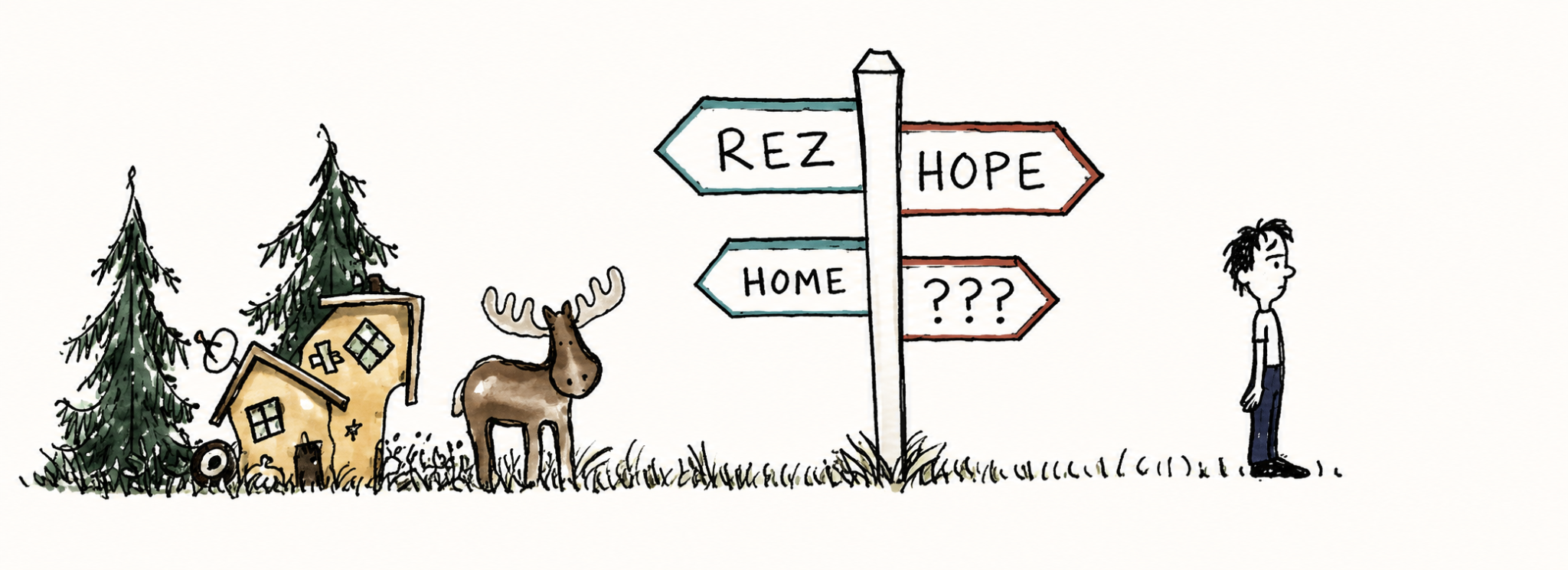
The rez calls Junior a traitor for leaving; Rowdy ends the book calling him a nomad. Which one is he, and what proves it?
Open the evidence ledger through Week 16 →Why does “nomad” fit Junior better than “traitor”? Use Rowdy’s words and the ending.
Rowdy sees Junior as someone who leaves to seek a life, like the nomads he has read about. He imagines Junior happy in another country and feels happy for him. Junior still loves Rowdy and his tribe. Their final game shows that leaving and caring can exist together.
Your notebook → your Aim Response
Choose your evidence here. Write your sentences in your notebook.
Explain why leaving felt like betrayal to someone.
Test the nomad label against a detail from the ending.
Explain which interpretation your evidence supports and what remains complicated.
The label ___ best fits Junior because ___; although ___, the evidence shows ___.
A starting shape, not the only way to write your answer. Replace the spaces with your own thinking.
The exact quotation, its context, and its citation will appear here.
In my own words, this means …
This helps answer the question because …
The exact quotation, its context, and its citation will appear here.
In my own words, this means …
This helps answer the question because …
Choose two different quotations. Then check that your writing explains every part of the aim.
The first detail shows … . But / So / Because … . Together, these details help explain … .
Choose the connector that matches your reasoning: but contrasts, so gives a result, because gives a reason.
This model answers a related question. Notice where the quotes, explanations, words, and appositives go.
Test the idea that leaving means rejection
Junior recalls the view during an earlier tree climb with Rowdy.
“And our entire world, at that moment, was green and golden and perfect.” (Alexie 226)Read in the chapter
Can help with: The ending.
Notice Rowdy’s changed response
Rowdy tells Junior about a dream in which Junior was traveling.
“You looked happy. And I was happy for you.” (Alexie 229)Read in the chapter
Can help with: The ending.
Examine the new label
Rowdy gives Junior a new description at the end of the novel.
“You’re an old-time nomad,” Rowdy said. (Alexie 230)Read in the chapter
Can help with: The ending.
Read an action after the new label
Junior describes the final basketball game with Rowdy.
“We didn’t keep score.” (Alexie 230)Read in the chapter
Can help with: The ending.
Take the earlier hurt seriously
Rowdy accuses Junior after hearing about his school choice.
“You always thought you were better than me” (Alexie 52)Read in the chapter
Can help with: The earlier label.
Keep the unfinished conflict
Junior expresses the guilt he still feels about leaving.
“I hoped and prayed that I would someday forgive myself for leaving them.” (Alexie 230)Read in the chapter
Can help with: The ending.
Keep the whole aim in view. Use an earlier chapter beside the ending. A character’s label is evidence of that character’s view; your judgment needs actions and explanation too.
Use one word from each of these 2 groups. Complete all 2 groups for the vocabulary points. Words separated by “or” are alternatives.
nomad (noun) — A person who moves from place to place rather than staying in one permanent home.
Calling Junior a nomad makes movement part of Rowdy’s new description of him.
Original writing example · More word help
scintillating (adjective) — Sparkling; or lively, clever, and very interesting.
A scintillating basketball play might impress a crowd, but the final game draws attention to the friends’ time together.
Original writing example · More word help
An alternative from a listed root family fills the same group. Review words in a practice model do not replace this list. Connect each word to your point; a made-up event is not evidence.
The words between the commas give another name for the noun.
Rowdy, another name for this person or idea, …
Rowdy, the friend who once saw leaving as betrayal, offers Junior another name.
“the friend who once saw leaving as betrayal” and “Rowdy” name the same person or idea. Keep both commas; finish with your own point.
Their final game, another name for this person or idea, …
Their final game, a shared activity without a recorded score, gives them time together.
“a shared activity without a recorded score” and “Their final game” name the same person or idea. Keep both commas; finish with your own point.
Point to the evidence in your own paragraph before checking a box.
These boxes are a self-check, not a grade. Development reflects how your argument builds and your growth as a writer. Checks stay in this browser.
Whose words and experiences help explain the accusation, and what do they prove?
Which choices or continuing bonds support Rowdy’s new description?
How do the earlier conflict and the ending work together in your answer?
Test the idea that leaving means rejection
Junior recalls the view during an earlier tree climb with Rowdy.
“And our entire world, at that moment, was green and golden and perfect.” (Alexie 226)Read in the chapterCharacters
The beautiful view belongs to an earlier memory with Rowdy. It shows Junior’s attachment to home, not proof that life there was always easy.
Notice Rowdy’s changed response
Rowdy tells Junior about a dream in which Junior was traveling.
“You looked happy. And I was happy for you.” (Alexie 229)Read in the chapterChange
Rowdy describes being happy for Junior in a dream about travel. This is evidence of acceptance at the end, not a promise about what everyone will think.
Examine the new label
Rowdy gives Junior a new description at the end of the novel.
“You’re an old-time nomad,” Rowdy said. (Alexie 230)Read in the chapterThemes
Rowdy connects Junior’s movement with a past he has read about. Test this interpretation against Junior’s choices; the label alone does not settle the whole question.
Read an action after the new label
Junior describes the final basketball game with Rowdy.
“We didn’t keep score.” (Alexie 230)Read in the chapterChange
Playing without a score gives the boys time together without a winner. It supports a renewed connection, while leaving their future open.
Take the earlier hurt seriously
Rowdy accuses Junior after hearing about his school choice.
“You always thought you were better than me” (Alexie 52)Read in the chapterCharacters
Rowdy reads Junior’s decision as a claim of superiority. This helps explain why leaving feels like rejection to him, without proving that rejection was Junior’s purpose.
Keep the unfinished conflict
Junior expresses the guilt he still feels about leaving.
“I hoped and prayed that I would someday forgive myself for leaving them.” (Alexie 230)Read in the chapterChange
Junior still struggles with guilt after hearing the new label. A hopeful ending can offer a way forward without making every cost disappear.
Keep the whole aim in view. Use an earlier chapter beside the ending. A character’s label is evidence of that character’s view; your judgment needs actions and explanation too.
Which earlier quotation best complicates the peaceful final game by showing how Rowdy once understood Junior’s departure?
In your notebook: explain what your second quotation adds that the first one could not show alone.
The rez calls Junior a traitor for leaving; Rowdy ends the book calling him a nomad. Which one is he, and what proves it?
Open the evidence ledger through Week 16 →Reading practice helps you prepare. Your Aim Response is the paragraph you write in your notebook. Check that paragraph against the rubric →
Use each choice once. These are practice sentences, not quotations.
The last chapter places a childhood beside a later conversation. In the remembered scene, a view from the tree shows a home Junior values. Later, Rowdy uses the word to describe someone who keeps moving. His dream places Junior at the Great Wall of , but that imagined scene is not a journey that has already happened. Junior still wonders whether they will know each other as old men, and Rowdy answers with . They then play without keeping . Read these details together while allowing for both renewed closeness and unfinished questions.
Drag the blocks or use the arrow buttons. Keyboard: focus a block and press Alt + ↑ / ↓.
In your notebook, pair one ending detail with earlier evidence that complicates it, then write a qualified judgment about Junior’s leaving.
Practice feedback is for you. These activities do not submit a grade.