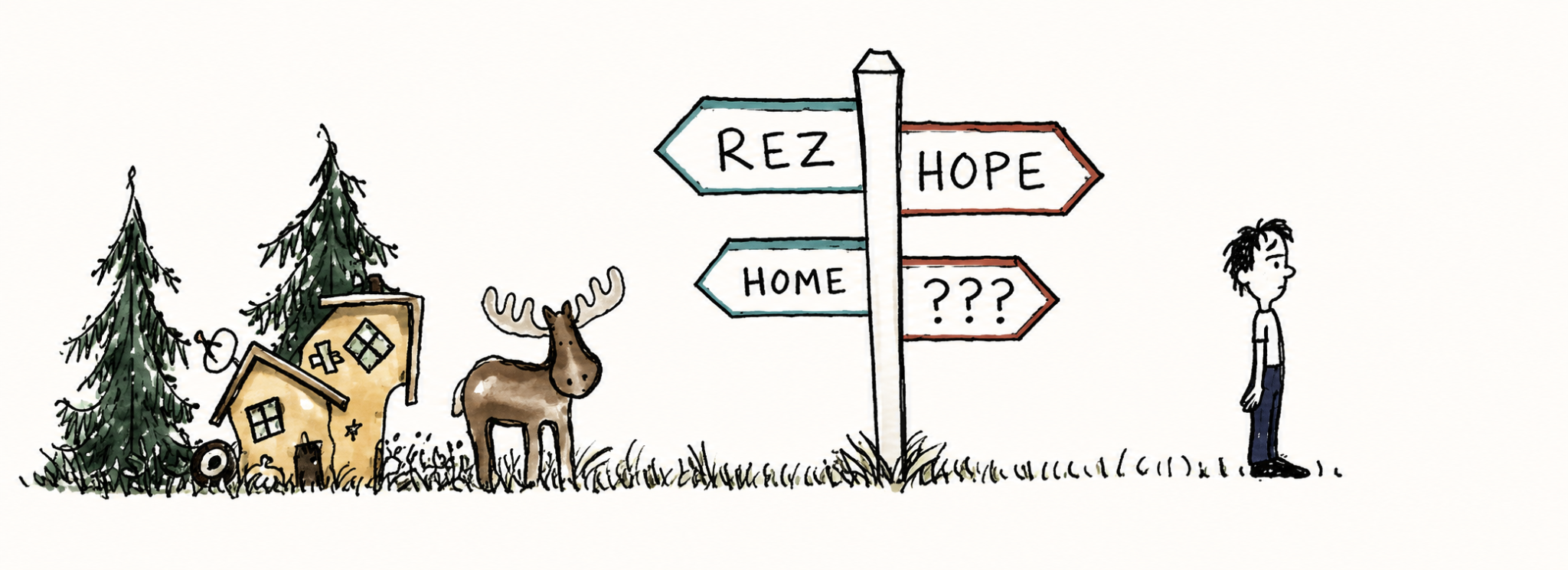
“Gordy believed in me. He wouldn’t let me give up.”
Margin note
Gordy gives Junior more than study tips. Junior experiences his persistence as belief in him, which helps explain why learning together becomes a form of support.
My notebook
Still confused → Gordy keeps helping → someone believes I can learn.
Junior has not understood the lesson, but Gordy keeps encouraging him.
What it helps explain
Gordy treats confusion as something they can work through together. Junior gains a person who expects him to succeed.
Your turn: another detail
Connect the two experiences
Junior connects Gordy’s reading lesson with taking lives and hopes seriously.
“I suddenly understood that if every moment of a book should be taken seriously, then every moment of a life should be taken seriously as well.” (Alexie 95)
Look again: Junior says the friendships are different. Explain what studying with Gordy gives him without claiming that Gordy replaces Rowdy’s secrets and dreams.
Weigh the quarter question
Cost
A damaged friendship or difficulty feeling at home.
Gain
A new chance to learn or an action showing support.
Judgment
How do these weigh against each other? What does “worth it” mean here?
What does Gordy give Junior besides help with homework? Use one detail.
Compare with one possible explanation
Gordy gives Junior a friend who believes he can learn. When Junior struggles, Gordy does not let him give up. Studying together helps end his isolation.
An alternative from a listed root family fills the same group. Review words in a practice model do not replace this list. Connect each word to your point; a made-up event is not evidence.
Introduce two people or ideas 2 appositives · 2 points
The words between the commas give another name for the noun.
Gordy, another name for this person or idea, …
See one that works
Gordy, Junior’s new study friend, takes reading seriously.
“Junior’s new study friend” and “Gordy” name the same person or idea. Keep both commas; finish with your own point.
Rowdy, another name for this person or idea, …
See one that works
Rowdy, Junior’s childhood friend, shares a long history with him.
“Junior’s childhood friend” and “Rowdy” name the same person or idea. Keep both commas; finish with your own point.
Junior does not understand yet, but Gordy still believes he can learn. Support includes staying with someone through confusion.
Connect the two experiences
Junior connects Gordy’s reading lesson with taking lives and hopes seriously.
“I suddenly understood that if every moment of a book should be taken seriously, then every moment of a life should be taken seriously as well.” (Alexie 95)
A lesson with Gordy changes how Junior thinks about a person’s life. Thinking about Mary helps turn the reading lesson into a lesson about taking someone’s hopes seriously.
Name Mary’s action
Junior describes Mary choosing a different life.
“my sister decided she needed to change her life.” (Alexie 89)
Mary chooses to leave a life that has kept her in the basement. Junior connects this change to his own move, but his guess does not tell us all of Mary’s reasons.
Keep the friendships distinct
Junior compares his friendship with Gordy to the one he shared with Rowdy.
“Not like Rowdy and me. We didn’t share secrets. Or dreams.” (Alexie 94)
Gordy’s friendship has limits that Junior names. A new friend can help him feel less alone without replacing everything he shared with Rowdy.
Find more evidence in the chapter
Chapter 12: Find the classroom disagreement with Mr. Dodge. Mark what Junior knows, how Mr. Dodge responds, and what Gordy does. How does the scene explain Junior’s loneliness and the beginning of a connection?
Choose a second quote that adds something
You used Gordy’s encouragement. Which second quote adds the missing part about how Junior sees Mary?
In your notebook: explain what your second quotation adds that the first one could not show alone.
Your evidence is building toward a bigger question
What has leaving the reservation cost Junior, what has it bought him, and was it worth it?
Use each choice once. These are practice sentences, not quotations.
A careful reader separates what happens from what a narrator thinks it means. Mary leaves home; Junior's claim that he inspired her is an . His comparison of family ties to strong helps explain why leaving feels surprising. In another scene, Gordy offers Junior through studying together. His river comparison first draws attention to the book's , or movement from scene to scene. Later, his questions about a word's origins ask for closer . These details give a reader different kinds of evidence; one detail should not be stretched to explain everything.
Blank 1: An explanation of what an event means, rather than the event itself.
Blank 2: The sticky material in Junior's comparison of family closeness.
Blank 3: The relationship Gordy and Junior build by studying together.
Blank 4: The story's sequence of events.
Blank 5: Careful notice of a word or detail.
0 of 10 checked
Follow the change in the library conversation
Drag the blocks or use the arrow buttons. Keyboard: focus a block and press Alt + ↑ / ↓.
Junior thinks about Mary's romance novels.
Junior and Gordy become friends who study together.
Junior connects taking a book seriously with taking a life seriously.
Gordy compares following a book's story to riding a raft down a river.
Gordy asks Junior to investigate a word's history.
Choose one phrase from Gordy's lesson and write one sentence explaining how it helps Junior see Mary or himself differently; cite the printed page shown beside the quotation.
Practice feedback is for you. These activities do not submit a grade.